



My Father was a Salesman.
He didn’t carry huge valises, or go on the road all the time — although he did go on the road. He sold computer services or software solutions and was fascinated with any kind of technology. He left Brooklyn and got married and bought a home and put two kids through college. When I was in high school, he built a side hustle with one of our neighbors - a Chinese immigrant, and helped create one of the first customer loyalty programs, that tracked customer behavior with rewards.
When I was in college he had contacts in France that took him to Paris on business a few times a year for a completely different business.
And of course he faced many bosses like Willy Loman’s in his later years. Especially during the Great Recession.
It is impossible to think about, write about or sit through Joe Mantello’s new production of Death of a Salesman without thinking of those years. How easy it is to judge people for their all too common faults. How hard it is to see that their delusions are as closely held as your own.
As I grow older, I’ve learned that the line between delusions of escaping current circumstances and dreams of better days is ephemeral and highly circumstantial.
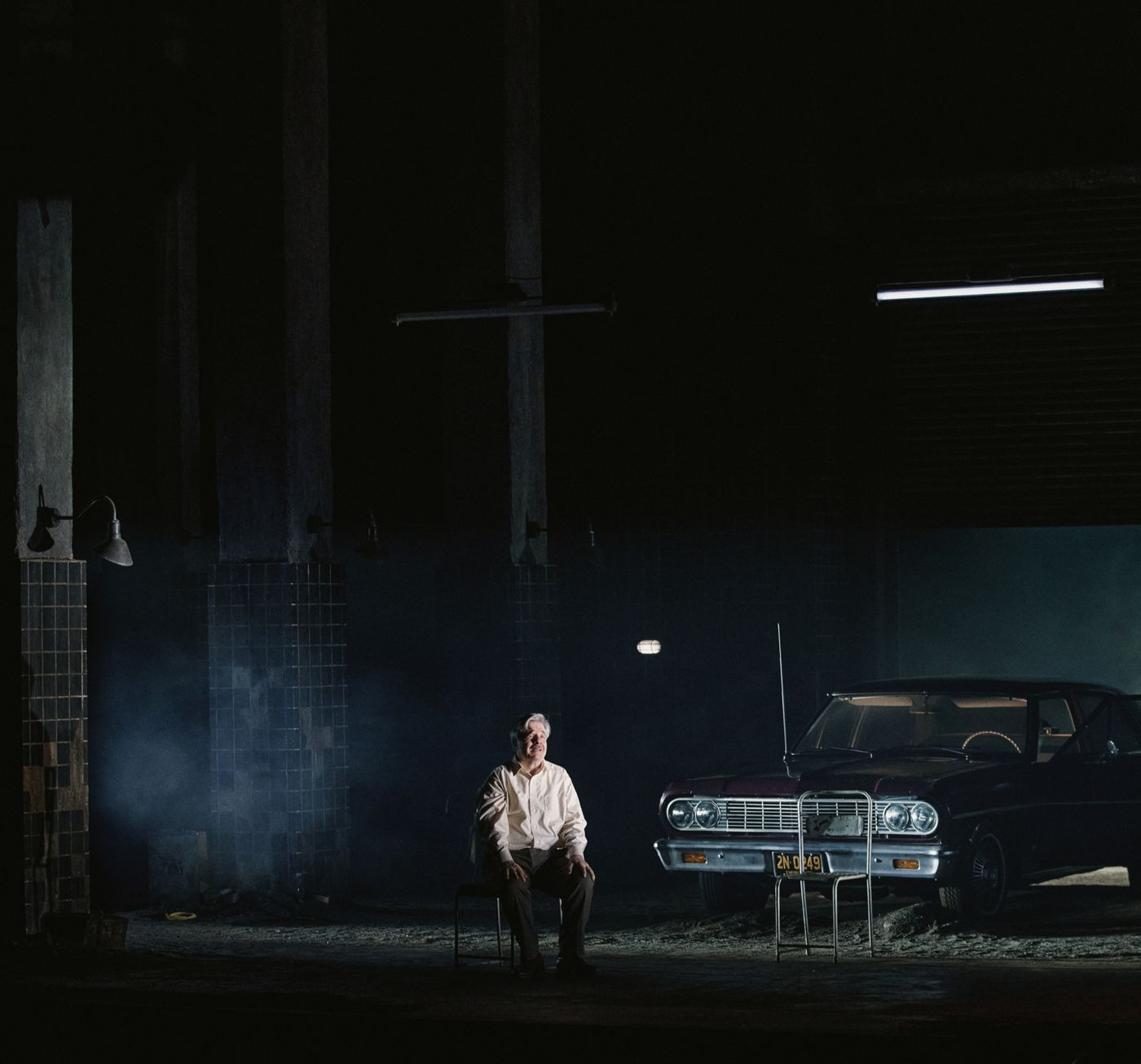
The cavernous set at the Winter Garden Theater never lets us forget these eternal truths. By obliterating the Loman home we are left only with memory. Or is it purgatory? Is the Loman home now just another Brooklyn industrial garage, haunted by spirits who once dreamed nearby?
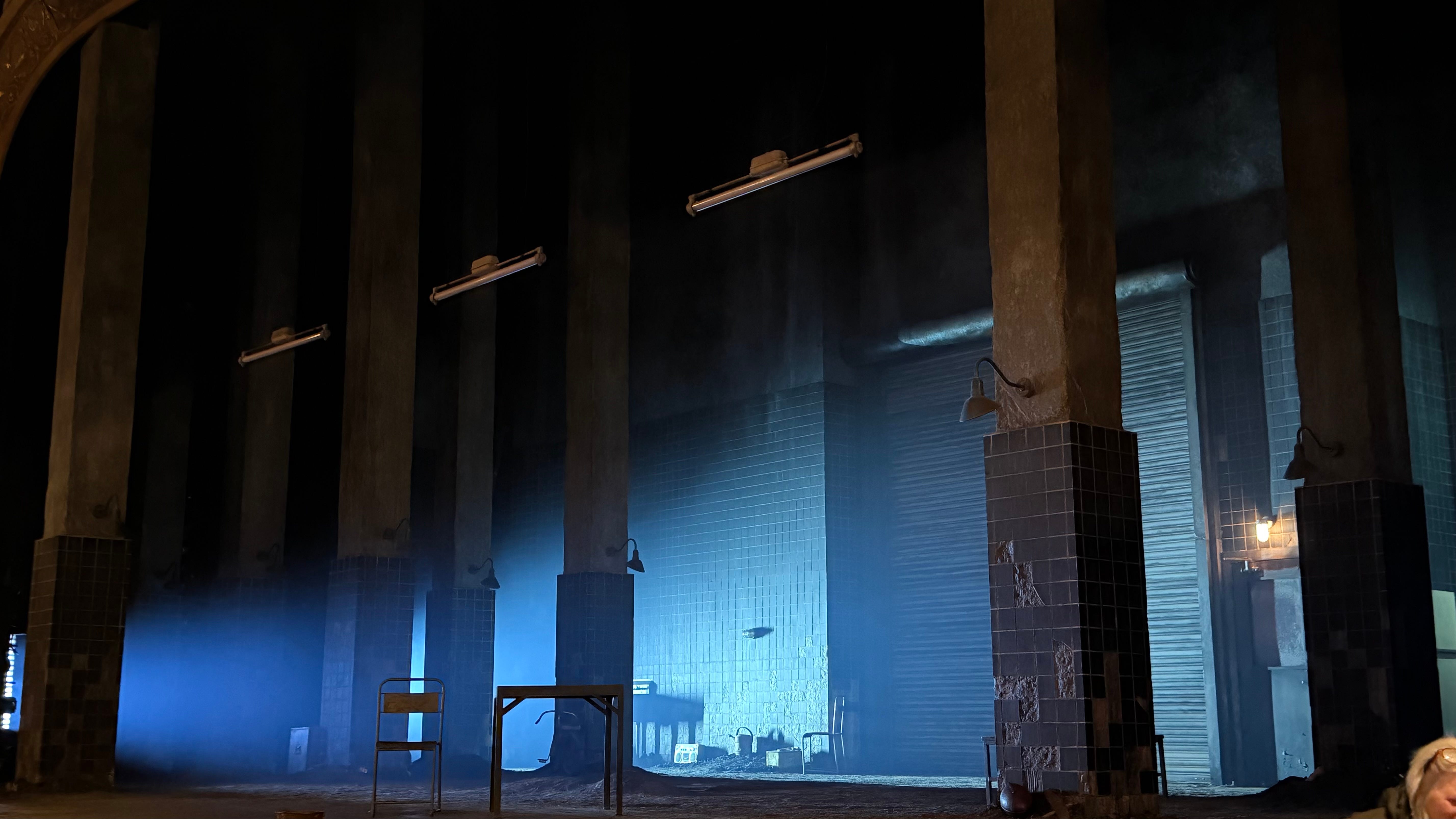
Time becomes unstuck in this intense dream logic. Basic props are pantomimed into furniture and appliances that comprise the Loman home - past, present and future, from the detritus found around the garage.
Willy and Linda Loman’s plain but proper clothing could be from the ‘40s or the ‘80s or now. The Loman Brothers stalk the stage comfortably in streetwear that could be considered contemporary or retro or both. Willy’s young boss Howard holds a disposable Starbucks cup and wears a tech bro fleece.
We are everywhere and nowhere all at once — only the warm light of nostalgia, or the cold stark light of reality offers navigation.
This highly intense minimalism1 revealed the Loman family’s tragedy more clearly for me than even the first time I read it in Dr. Coleman’s 11th grade AP English in 1992.
Arthur Miller was consciously working with some powerful stuff when he crafted what is likely the greatest American play. In his 1949 essay Tragedy and the Common Man he spoke of the eternal truths that Death of a Salesman sought to embody:
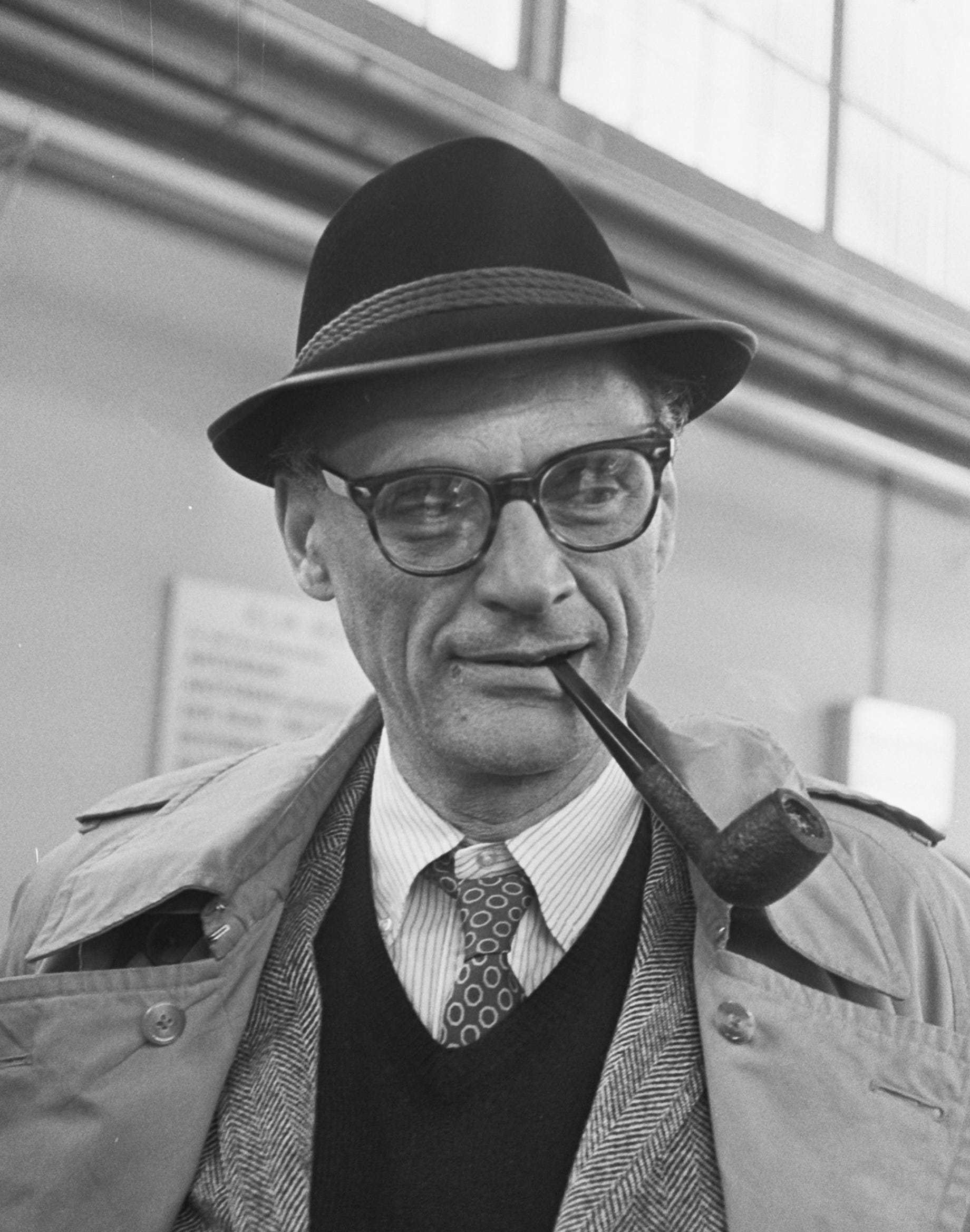
The tragic right is a condition of life, a condition in which the human personality is able to flower and realize itself. The wrong is the condition which suppresses man, perverts the flowing out of his love and creative instinct. Tragedy enlightens-and it must, in that it points the heroic finger at the enemy of man’s freedom. The thrust for freedom is the quality in tragedy which exalts. The revolutionary questioning of the stable environment is what terrifies. In no way is the common man debarred from such thoughts or such actions.
-Arthur Miller
By disorienting us in time and place, we can truly see the tragic quest for freedom. Far from pathetic, Miller’s “common man” is exalted for seeking something greater than his “stable environment”.
And it is in these moments of warped nostalgia, where Nathan Lane’s Willy Loman truly distinguishes himself. His Willy Loman is not Dustin Hoffman’s nervous “little shrimp” or Brian Dennehy’s broken down lug — but a faded and degraded star. His confidence and laugh are still infectious2. It’s easy to see why his boys love and idolize him. Sure he spouts a ton of bullshit. But he is actually and truly well-liked. When he reveals to Linda his real commissions, his self-doubts almost read as imposter syndrome.


Willy Loman owns a home filled with love and beautiful children. Does anyone dare blame him for dreaming of more? In America? Do we really judge him for feeling inadequate despite those blessings?
Nathan Lane makes you question much of Willy Loman’s “loser” status. He is so charming to his boys, his wife, his mistress, that we can almost forget the tragedy that is actually unfolding in front of us.
I am a Salesman.
I work in public relations and help other companies (mostly in financial and professional services) and their executives communicate to the market. I help my firm source and develop new business. Despite having a legal education, I never really practiced3 and instead use my training to help companies navigate sensitive situations.
Like Willy Loman, and my father, the Salesmen of the 21st century “must dream” in order to succeed. And while our valises are Outlook threads, Teams meetings and PowerPoint decks, anyone who has ever had to “make target” understands the warm thrills of winning business, makes those burdens so much lighter. And so we dream anew each day.
But losses come too. And sometimes they come in bunches. And then the fear. And then the dread.
To lose confidence — to give into fears that your time is up, or never came. That you’re to be replaced by someone or now SOMETHING that is better and faster and cheaper. That the smiles will stop. That your children will leave. That your spouse doesn’t care enough. That your hat will pick up those spots.
Oh I think this is a very 21st century fear indeed.
This fear of loss IS the fear of our day. And its impact is the core of Laurie Metcalf’s all time, and perhaps definitive 21st century portrayal of Linda Loman.
Without raising her voice, Laurie Metcalf summons reserves of emotional steel that I have only seen before from Lise Davidsen’s Isolde and Elza van den Heever’s Salome. She is both Willy’s enabler and his tether to Earth. She is well aware that Willy is a bit of a showman, and she is in love with that. And like Isolde - she is compelled to love - despite the great and deep wounds that it inflicts upon her soul.
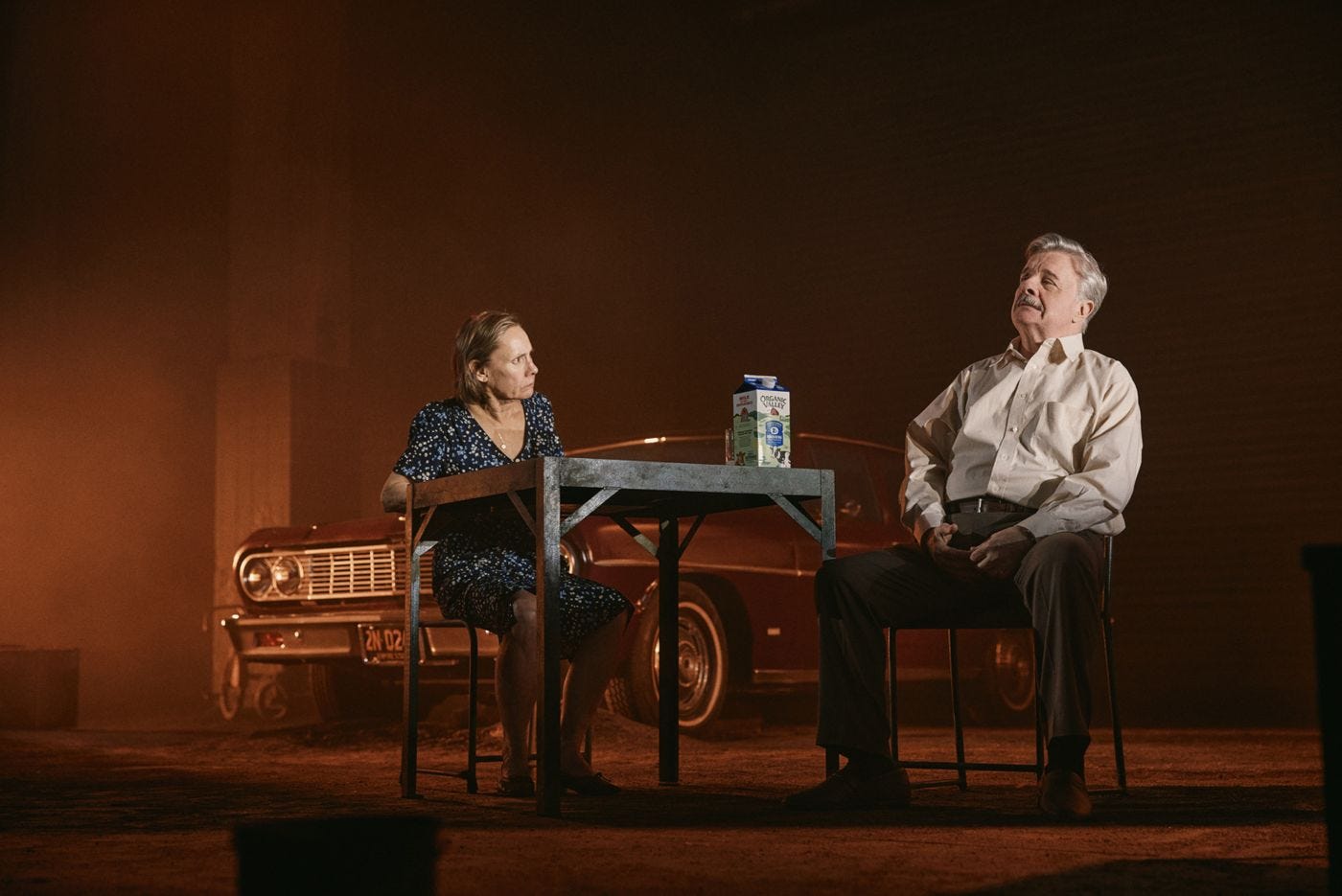
I have always thought that Linda Loman knows of Willy’s infidelities. In Laurie Metcalf’s performance I am downright convinced that she knows. It’s but one more indiscretion that she is willing to bear. She tells her children clearly and calmly the truth of who their father is, and who they are4 and still demands that “Attention must be paid!”
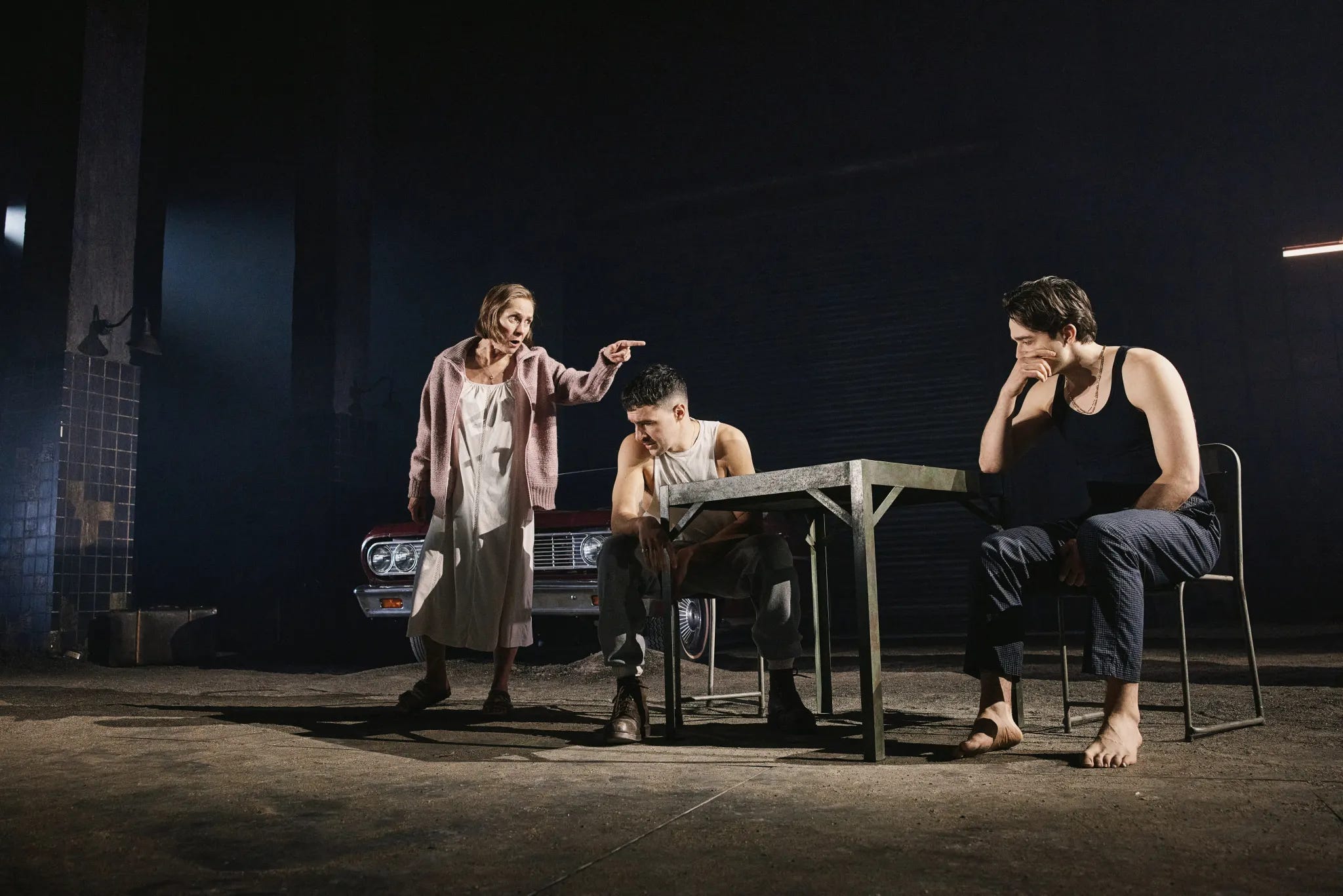
So often a cry of despair, is in Metcalf’s performance, a clear statement of hope and dignity. It’s a faith that despite our sins - if we love and we are loved, then attention and indeed respect must be paid. The judgment of other men is false. The greater moral truths remain true.
Was there a dry eye in the house? It did not look that way to me.
Linda remains the moral center of a play in desperate need of an anchor. By centering the play on Metcalf’s inner strength, the scars she bears and incurs feel bloody but sanctifying. There is never any doubt that this Linda would not cry at Willy’s funeral.
It is a performance just as powerful as Lise Davidsen’s epic Liebestod.
I pray my Son is not a Salesman
He’s only ten. He pulls straight A’s and plays trumpet in his school jazz band. He has a ton of friends he plays ball with. He watches the Mets with devotion and memory and genuine feeling. He is well-liked.
But in our middle class suburb, the competitive drives start early and often. Parents will start discussing their kids’ college goals in elementary school. To their credit, our schools have a well-funded and strong commitment to arts and music education. But we also pay some of the highest property taxes in the nation - so I recognize it is a paid for privilege.
But with creeping AI, “maxxing” masculinity, and algorithms that deliver customized entertainment, I am incredibly grateful that he has been given options for human dreams. Satisfaction that can’t be maxxed out through “mogging”, or staring at a screen. A soul that can’t be disrupted or replaced by a talking machine.
Because I’ve seen what happens to well-liked boys in the Loman house. After all, Biff and Happy Loman were once boys too.
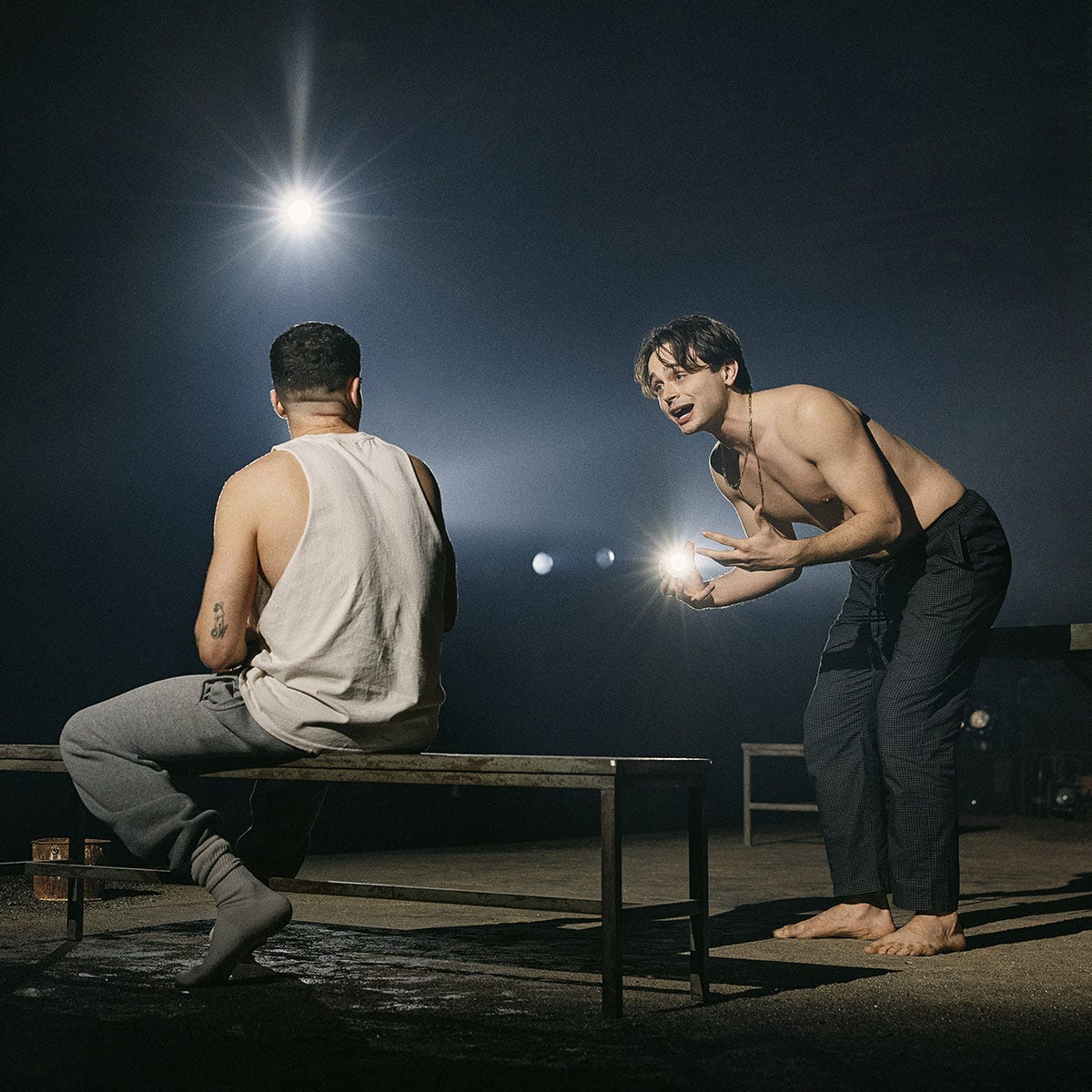
Mantello casts four actors as the Loman brothers — Christopher Abbott and Ben Ahlers as the men, Joaquin Consuelos and Jake Termine as the teenagers — and both versions haunt the stage at once. We don’t just remember who Biff and Happy were. We see them in the full flower of their youth. Boys who played ball, idolized their father, believed the world would open for them. They stand right there alongside the men who live with their dashed hopes.
Time doesn’t pass in this production. It accumulates.
Ahlers plays Happy as a “Manosphere” avatar. He allows Miller’s words to show how being alpha enough, maxxed out enough, and “ruining” enough women, is not exactly a new solution being offered to lonely men.
Happy is still the little boy tugging at Willy’s sleeve, asking if anyone noticed he lost weight. Screaming for attention and meaning. And like his father, when he finally gets the attention he craves, he devalues it. In the restaurant, with Willy unraveling before his eyes — needing his son for the first time — Happy leaves him to chase women.
The son becomes his father’s id. All appetite. No conscience.
When Ahler’s Happy declares at the funeral that he’ll win it for Willy, his belief is reinforced 1000x fold. It’s a terrifying moment. All of us know the rage he will feel and victims he will choose when he learns the game he’s playing is “rigged”.
Biff is something else.
Where Happy is Willy’s id, Abbott’s Biff becomes his conscience. The part of Willy that knows the truth but can never speak it. There’s a whiff of reformed menace to Abbott’s Biff. After the shattering discovery of Willy’s adultery in the Boston hotel room, he opts out.
First out of fear and hatred for the real world his father had lied to him about. Then, as he tells us, because he was so full of hot air and entitlement that he could never hold a job that asked him to start small.
I thought about my nephew and his generation.
Last fall, we went to see Don Giovanni at the Met. He’s a young man in his mid-twenties navigating the particular difficulties of his generation. Attending “remote college” during Covid and then thrust into an algorithmic world promising cheap connection while delivering isolation. Derek Thompson famously called this generation of young men “monks in the casino.” Risk-averse socially. Risk-chasing financially. Living in rooms full of screens.
Isn’t pinning your hopes on a big crypto or event market/sports bet “win” at least as farcical and pathetic as Biff’s plan to ask for $15,000 from a former boss he stole from?
The monks in the casino are men so entitled to a certain vision of life that they’ve opted out completely when reality failed to deliver it. Their delusions are masked with digital toxins — the feeds, the bets, the parasocial worship of men who’ve made the numbers — but it’s an opt-out just as total as Biff’s years of drifting.
A refusal to take the small job or start from nothing.
I’m proud of my nephew for bucking this trend. For taking a hardworking path that is leading to larger things. And I had him in mind during Biff’s redemption.
When Abbott cries out “I’m nothing, Pop!” it is far from a defeat. It is a cry of freedom! Freedom from expectation, from the fear of loss, from the fear of greatness.
Freedom from the crushing obligation to be well-liked, to make the numbers, to carry a name that was never as big as Willy believed.
He is Willy’s conscience made flesh — saying the true thing, the unbearable thing, the thing that could save them both if Willy could hear it.
My Grandfather was a Salesman.
Not the corporate kind. He sold signs — office signs, novelty signs — to mom and pop businesses in Brooklyn and Monroe, NY and Miami Beach. He had little places in each of those cities. A Brooklyn apartment in Canarsie that was still the projects. A summer place in Monroe with a spectacular view of the mountains and trees. A place in Florida he could go when it got cold.
The man grew up in an orphanage and lived long enough to fly on a private plane with his famous nephew. And he brought five pounds of Munster cheese on that private flight because it was cheaper and better in Brooklyn.
He prayed every morning. Ancient rituals, unchanged since before I was born. When I was a kid I couldn’t understand why. Why he kept to these prayers despite all the progress he’d seen in his lifetime. Why he was so happy with three little places when he could have had two big ones. Why he was so uninterested in the wider world beyond reading the box scores.
Now I understand. And the lack of religion or any faith in anything greater than themselves seems to be a screaming silence in the text. The Lomans judge themselves only by material standards - the estimation of other people and accumulation of status and influence. But the material world leaves your faith and destiny in the hands of other men.
And like Willy it will always leave one “temporary”.
My grandfather’s faith was not in other men. It was not in worldly things. He never let material circumstances bar his happiness or crimp his faith. He lived by the rules of his religion and his conscience. He measured himself by his own standards. And he died a happy man with fulfillment in his heart.
The 21st Century Salesman is Already Dead
In 2026, the talking machine has won.
It is no longer sitting on Howard’s desk as a curiosity. It writes the emails. It makes the decks. It scores the leads. It is coming for every Salesman — every PR executive, every lawyer, every accountant, every writer, every man or woman who ever made target and felt that warm thrill of winning business or a commission or a paycheck for a job well done.
Howard himself will be replaced. AI is an endless bowl of fruit without peels.
The 21st Century Salesman is already dead.
The fantasy that being well-liked on the internet will save you. The optimized, maxxed-out, alpha-performed life that so many young men are choosing — the swagger without foundation, the cycle that just gets louder. These ideas will die because they are already dead.
Like the Lomans they are ghosts in purgatory, summoned back to life in every American era.
Arthur Miller wrote that “the tragic feeling is evoked in us when we are in the presence of a character who is ready to lay down his life, if need be, to secure one thing — his sense of personal dignity.” It “implies more optimism in its author than does comedy… The possibility of victory must be there.”
The tragedy is Willy’s. Nathan Lane makes you feel the full weight of it — his charm, his youth, his vitality and his love, all thrown into a rigged contest. But the possibility of victory — the optimism that Miller insisted tragedy must contain — belongs to Biff. To his cry of freedom. To his willingness to face who he is and survive it.
This production is the Death of a Salesman for the 21st century, because it holds Biff’s humanist redemption as its promise, and Happy’s frightful turn as its warning.
Nathan Lane, Laurie Metcalf, Christopher Abbott and this extraordinary company have given us the production that our moment demands. In the purgatory of the Winter Garden Theatre, where time is unstuck and the Loman home has long since fallen away, they follow the bright thread that Miller asked us to pick up seventy-seven years ago — and they carry it to the only place it can possibly lead.
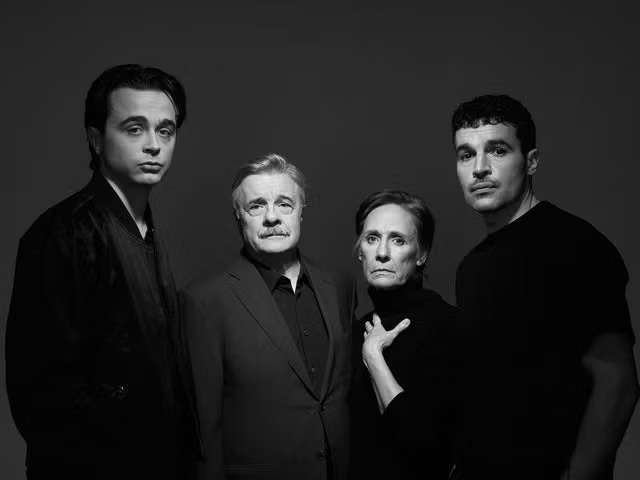
“It is time, I think, that we who are without kings, took up this bright thread of our history and followed it to the only place it can possibly lead in our time — the heart and spirit of the average man.” - Arthur Miller
The 21st century Salesman must die. So that the “common man” can finally live.
Go see this production now.
One is reminded of Guth’s Salome and Don Giovanni the Metropolitan Opera, but America-coded and on a far more intimate scale
If not quite as infectious as in the Birdcage.
A few arbitrations won in the early 2010s doesn’t count except for my ego
When she knowingly calls Happy a philanderer - her Roseanne/Big Bang Theory sitcom timing flashed, and absolutely killed.