



Since September 11th, whenever the world gets particularly dark, I turn to the Marx Brothers.
I can’t fully explain it. It’s not escapism. You don’t escape into their madcap world any more than you escape into a fire alarm. But it is a reminder that the world’s absurdity isn’t unprecedented, and should absolutely not be met with grave solemnity.
Earlier this week — with the ongoing bombing of Tehran, the Strait of Hormuz essentially closed, Americans scrambling to evacuate the Middle East, oil prices surging, and the news delivering its nightly buffet of horrors — I sat down with my ten-year-old son and put on Duck Soup (1933).
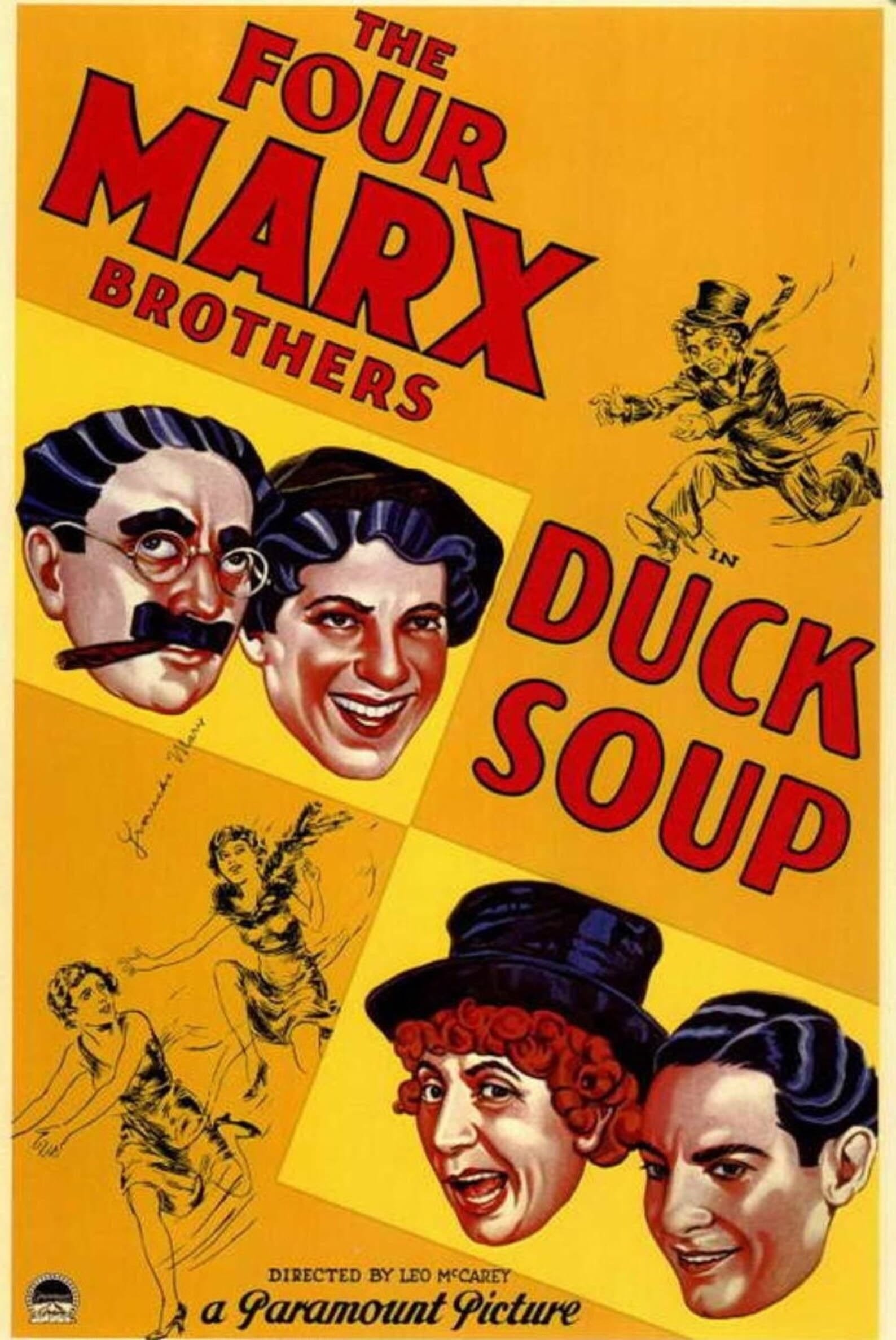
He loved it.
As always, the Marx Brothers are dialed into the sensibilities of your average ten-year-old boy. He is not, I should note, into this movie for the political commentary. So he loves Harpo’s scissors. His horns. He loves Groucho’s zingers even when he doesn’t fully get them because anyone can see that Groucho is a force of chaos. By the end, he was singing along with “We’re Going to War” and hysterically laughing at their ridiculous faux-minstrel show.
Because it IS hysterical. All of it. The lemonade stand. The mirror scene. Chico selling peanuts while the state crumbles. Freedonia marching into battle because Groucho’s Rufus T. Firefly got insulted at a garden party.


My kid was rolling.
And so was I. Because the Marx Brothers said all there is to say about politics, war and the elite in 1933. Other than Rules of the Game (1939), no other film quite grasps the absurdity of a descent into darkness.
And with all due respect to Jean Renoir — this has better gags.
So where’s our Duck Soup?
Duck Soup is the anarchist demolition of political order and my pick for the best political comedy of all time. The Marx Brothers were four sons of Jewish immigrants from the Upper East Side who looked at the rise of fascism, the collapse of the global economy, and the parade of nationalist strongmen promising to make their countries great again and never, ever broke character. There’s no pivot to sincerity. No Oscar-bait, “socially aware” monologue.
Just pure and honest chaos as the only authentic response to a world losing its goddamn mind.
I’m sure people could make the case that there were funnier people than the Marx Brothers. But I wouldn’t want to hang around them.
What distinguishes their comedy is its precision. Beneath the apparent mayhem lies meticulous craft — Groucho’s wordplay, Harpo’s physical comedy, Chico’s con-artist logic all operate as a coordinated assault on elite, bourgeois pretensions. They represented the kind of ethnic outsiders unwelcome in “proper society.”
Duck Soup takes that class warfare and aims it at the state itself. Rufus T. Firefly IS the strongman — appointed dictator of Freedonia by a wealthy widow because he flatters her. He governs by insult, declares war over a personal slight, and leads his nation into catastrophe while never once dropping the wisecrack.
The country follows him anyway.
Every authoritarian leader in history has depended on the population taking the project of national greatness seriously. Duck Soup takes the project of nationalism and careless warmongering to its logical conclusion. The world ends, but the gag continues.
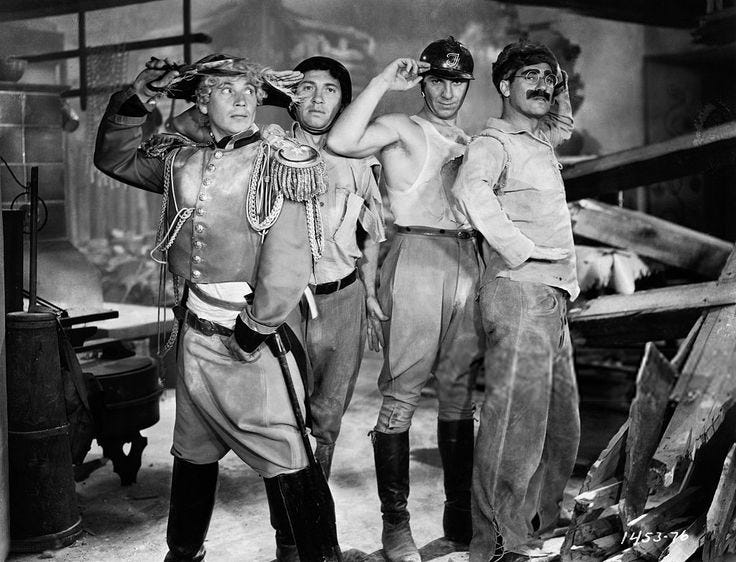
There is only the joke — and the terrifying realization that the joke is all there ever was.
Everyone Has Their Reasons
Six years later, Jean Renoir made the mirror image. And except for when it was released, Rules of the Game has never been more relevant than right now.
Where the Marx Brothers demolish order through anarchic energy, Renoir reveals an order already dead on its feet.
Rules of the Game unfolds at a weekend hunting party where the French ruling class, consumed by petty affairs, hollow rituals, the mechanical performance of social position — drifts toward catastrophe.
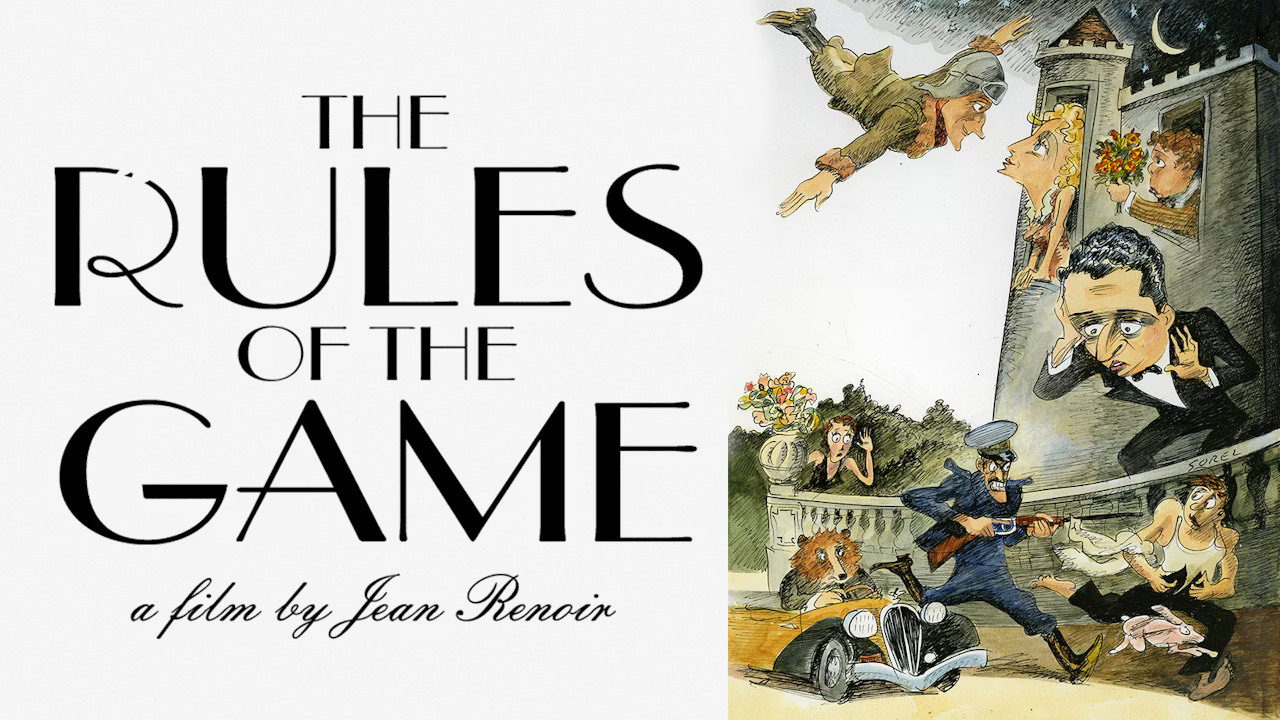
The Marquis de la Chesnaye proudly displays elaborate mechanical music boxes while his marriage crumbles and his servants plot. These are people performing civilization rather than practicing it — going through the motions of social grace while the human connections underneath have rotted completely. We see all the trappings of the pre-War bourgeois order, hollowed out by decadence, rationalizations and boredom.
They are ridiculous and absurd, and yet the individualist creed each character embraces would hardly be out of place in a modern article about Looksmaxxing, or inceldom, or “sexual market value” that details the loneliness and decay plaguing our own modern society.
“Everyone has their reasons.”


As the film progresses, the hunting party slaughters rabbits with industrialized efficiency. Renoir is showing you exactly what’s about to happen to Europe. The camera lingers on the animals’ twitching bodies. It’s one of the only moments in the film where the comedy completely drops away — because Renoir needs you to see what mechanized killing actually looks like before the rest of the world finds out.
And then comes the ending.
Octave’s friend André Jurieux — a heroic aviator, a genuine man of feeling in a world of performed emotion — is shot dead by a jealous gamekeeper who mistakes him for someone else. An accident born of the same farcical chaos of mistaken identities and bedroom intrigues that’s driven the whole weekend. The comedy kills someone. And nobody stops.
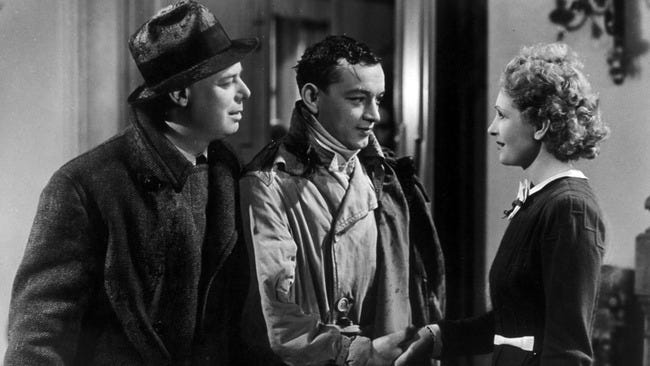
The Marquis steps onto the terrace and addresses his guests. A regrettable accident, he explains. A deplorable accident. These things happen. The guests nod. They accept it. They go back inside. The weekend will continue. The rules of the game — the social contract that allows the powerful to manage their affairs without consequence — have absorbed the death and moved on.
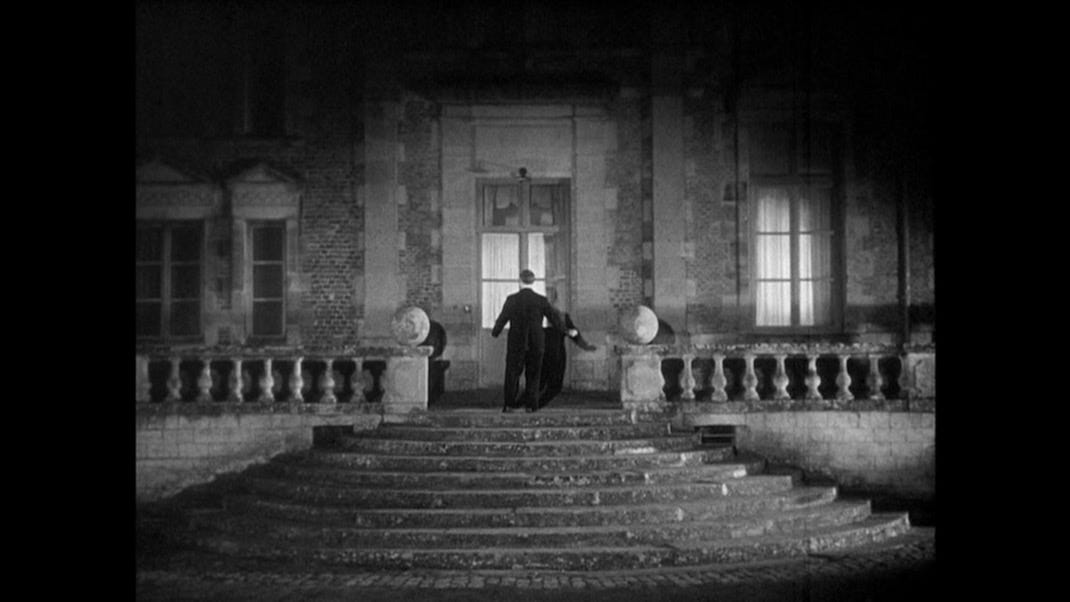
“Everyone has their reasons.”
In context, it’s devastating. The jealous gamekeeper has his reasons. The cheating husband has his reasons. The collaborationist government that would surrender France within a year had its reasons. The bourgeois ruling class’s infinite capacity to explain away anything — including its own destruction — as reasonable.
It is an all too familiar feeling.
The audience at the 1939 premiere knew it too — they were so outraged by seeing themselves in Renoir’s mirror that some reportedly tried to set the theater on fire. The French government banned the film as “demoralizing.” Within a year, that same government would surrender to Hitler and collaborate with the occupation.
A mechanical music box performing its little tune while the world around it burns.
The Courage to be Absurd
As we head towards the Oscars, several of the most politically engaged American films are rightly being celebrated for exploring our own society’s decadence. One Battle After Another, Eddington, and Marty Supreme all ask some version of the same question — what is wrong with the American dream? Why does everyone perform their politics instead of living them? Was it all myth, or are we in some sort of terminal and absurd decline?
These are brilliant films. I love them. I’ve written about them at length. But ultimately not one of them has the courage of a Renoir or a Groucho.
Paul Thomas Anderson’s One Battle After Another certainly has comic energy, absurdist set pieces, the genre-hopping madness of a filmmaker working without a net. But he can’t let the joke be the ending. His heroes have to choose family over ideology. The revolution has to resolve into the daily act of staying.
Ari Aster’s Eddington is a film without heroes that refuses to take sides politically because it understands that our crack-up is not political, but personal and psychological.
Every character is performing. And their performances serve powers that profit from division. The data center being built outside town advances its agenda regardless of who’s in charge. While the town tears itself apart, algorithmic capitalism quietly advances. That is Aster’s masterstroke — darkly funny in the way Kafka is funny. But he frames it as horror. But unlike the Marx Brothers who found absurd humor in everything, the data-center’s ribbon-cutting isn’t a classic punchline, but more of a nightmare.
And then there’s Marty Supreme — the closest thing 2025 produced to the manic energy of the Marxes. Josh Safdie understands something essential about the American hustle: it’s not a system you can game. In an age of rising anti-semitism, putting the very specific Jewish culture and struggle at the center of the American dream — and showing its limitations — might actually be brave filmmaking. But even Safdie has to land on meaning, with a fully sentimental, and dare I say it, classic Hollywood happy ending.
Courage, Not Distance
The Marx Brothers and Renoir were closer to the fire than any American filmmaker working today. The Marx Brothers were sons of Jewish immigrants in a country where like now, antisemitism wasn’t subtle — where quotas kept Jews out of universities, where Father Coughlin reached thirty million listeners preaching hatred. Renoir made Rules of the Game months before the Nazi invasion and had his film banned by the very government that would soon collaborate with the occupiers.
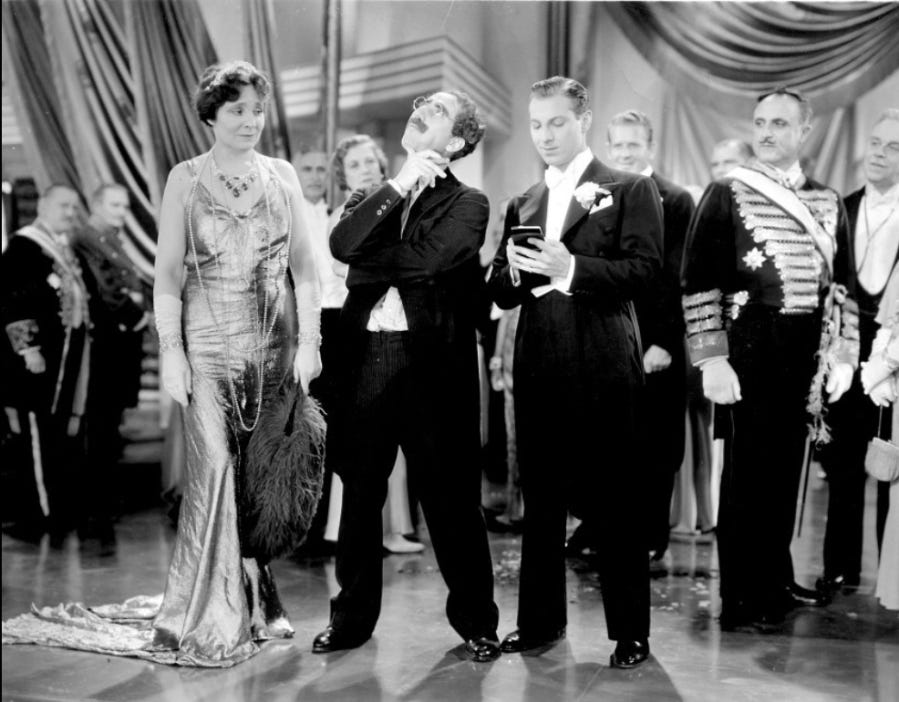
The Marx Brothers recognized that solemnity in the face of these horrors was itself a form of surrender. The strongman WANTS you to take him seriously. The machinery of authoritarian power depends on everyone agreeing that this is all very grave and important and deserving of careful analysis.
Duck Soup says: No. It’s a joke. A terrible, dangerous joke being played on the entire world. And the only proper response to a joke is to laugh at it.
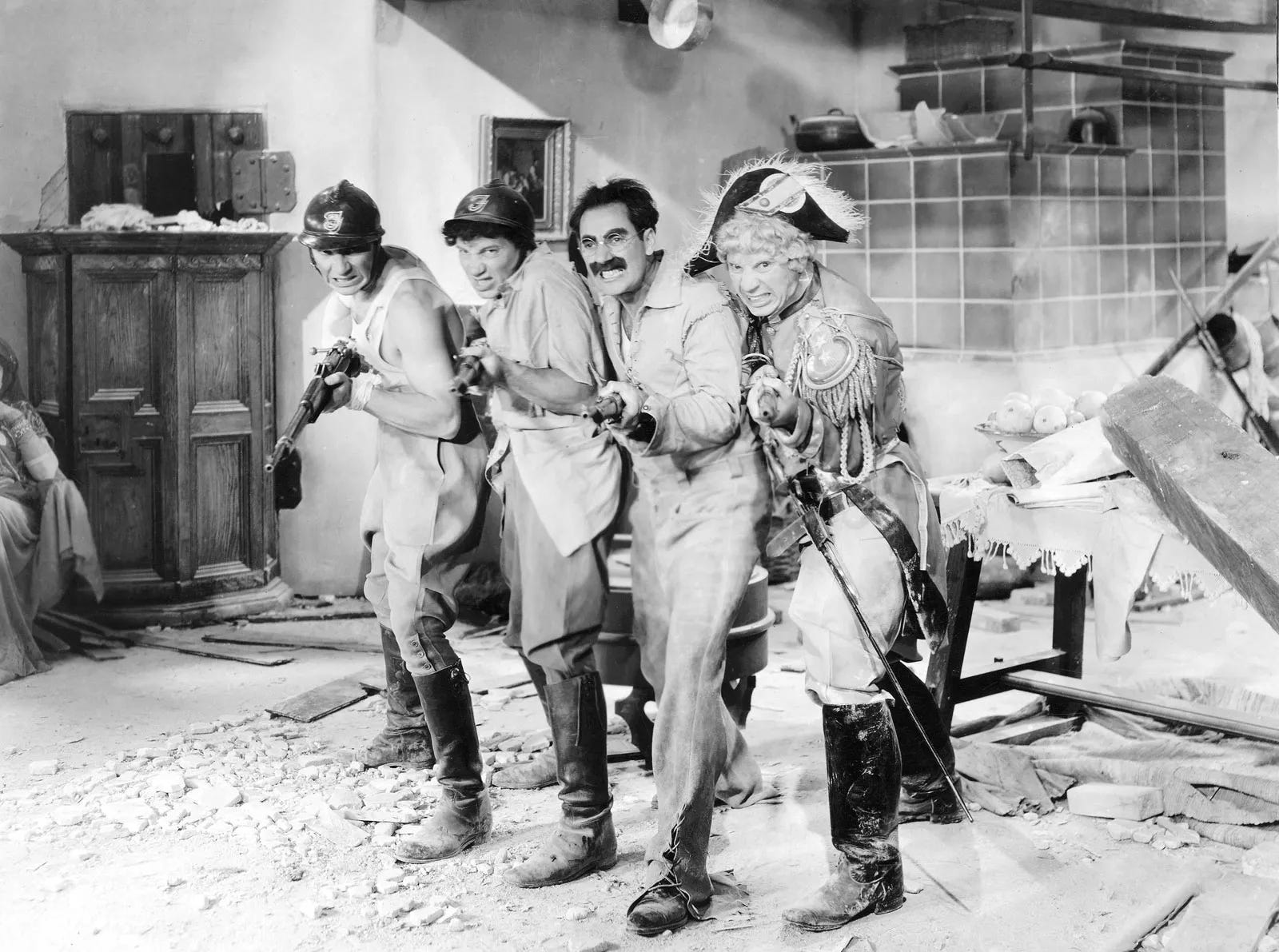
Even our best filmmakers are too careful for that now. Too aware that every frame will be parsed and discourse-ified within hours of release. They make brilliant films about the absurdity of American life but they can’t quite surrender to absurdity itself.
But my son — singing along with “We’re Going to War” while the real one plays out on the other screens in the house — he understands absurdity instinctively.
I worry it will be a skill he’ll rely on more and more in this world.
I love the Marc Brothers. Duck Soup is a masterpiece.