



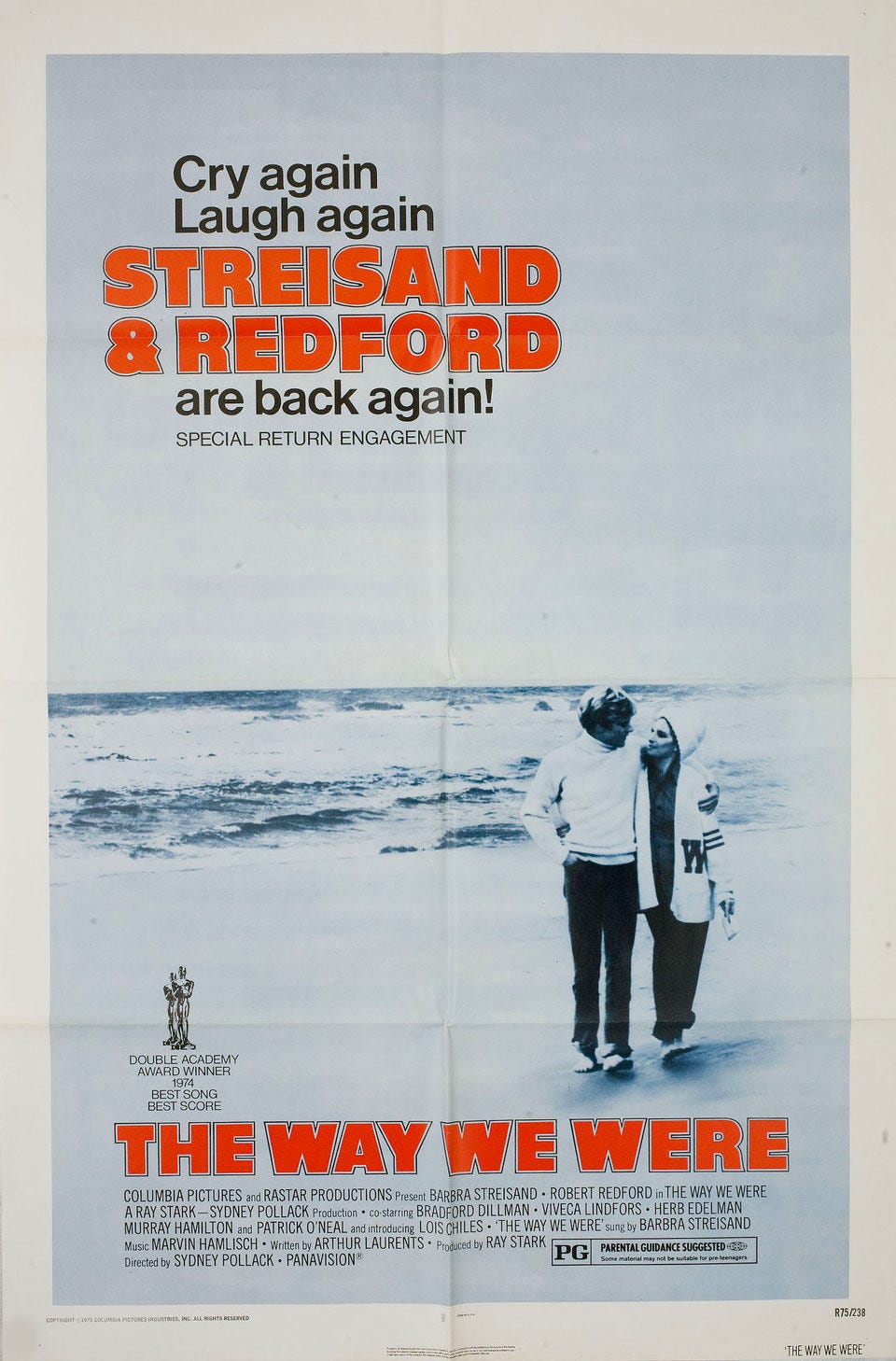
Much as I hate to admit it, my Boomer parents were right about Barbra Streisand and Robert Redford.
Sydney Pollack’s The Way We Were is a perfect piece of pop romantic filmmaking. It is grand and epic and embraces politics and history with a dollop of schmaltz that makes it go down incredibly easy. It's a throwback to classic Hollywood, made just as New Hollywood naturalism was taking over.
On Sunday, September 27, the Cognitive Film Society is proud to open its Fall season at the Gold Theater with The Way We Were in tribute to Robert Redford — the biggest movie star of the 1970s, who died a year ago at age 89.
Misty and Watercolored
Early in The Way We Were, a writing professor reads Hubbell Gardiner’s short story aloud to the class. It opens: “In a way he was like the country he lived in, everything came too easily to him.”
For fifty years people have assumed that line was about Redford. The face, the hair, the Butch Cassidy grin. He hated it. “Glamour image can be a real handicap,” he said once. “It is crap.”
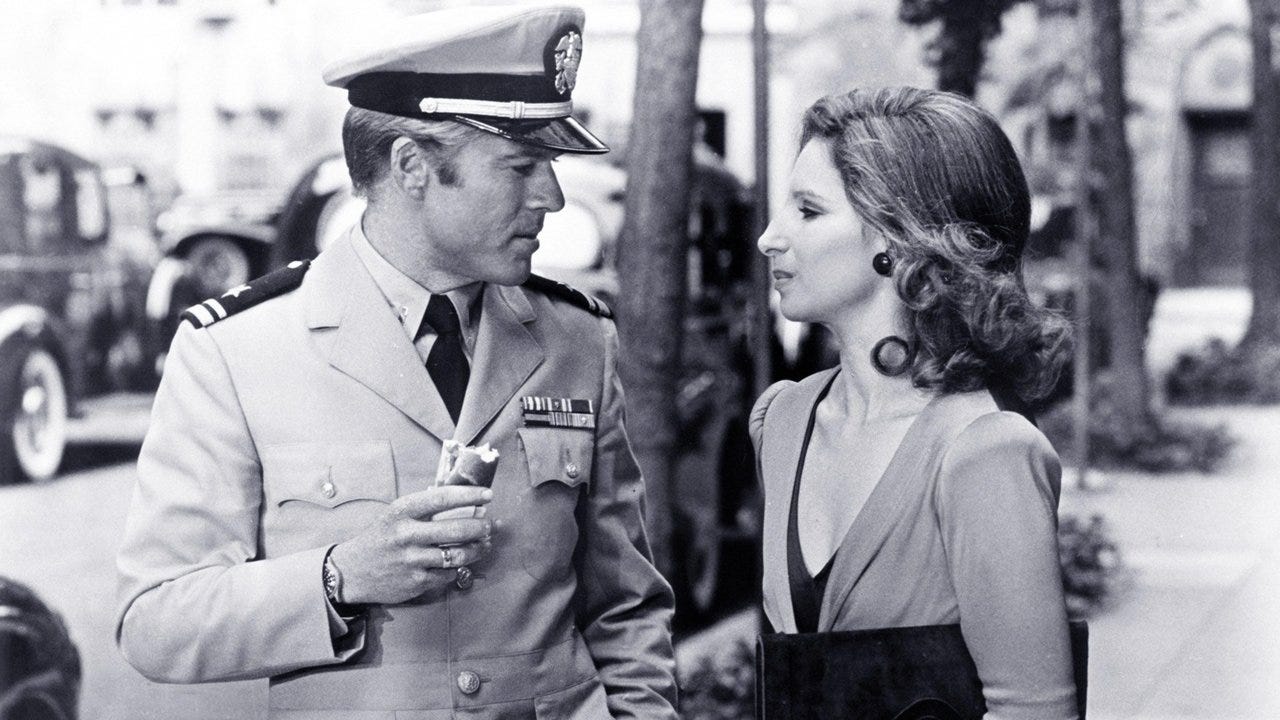
As Hubbell Gardiner, Robert Redford plays a man who goes along to get along. He moves to Hollywood, sells his novel to a studio, and when the blacklist comes for his friends and his wife, he is left in a moral quandary.
Scattered Pictures
Redford almost turned the part down. He thought Hubbell was one-dimensional and wanted “some justification for it, some reason.” Pollack, who’d been his friend since they acted together in War Hunt (1962), wrote him a letter insisting Hubbell was “the most sophisticated character” in the script, and kept telling everyone that without Redford the picture “literally wouldn’t work.”
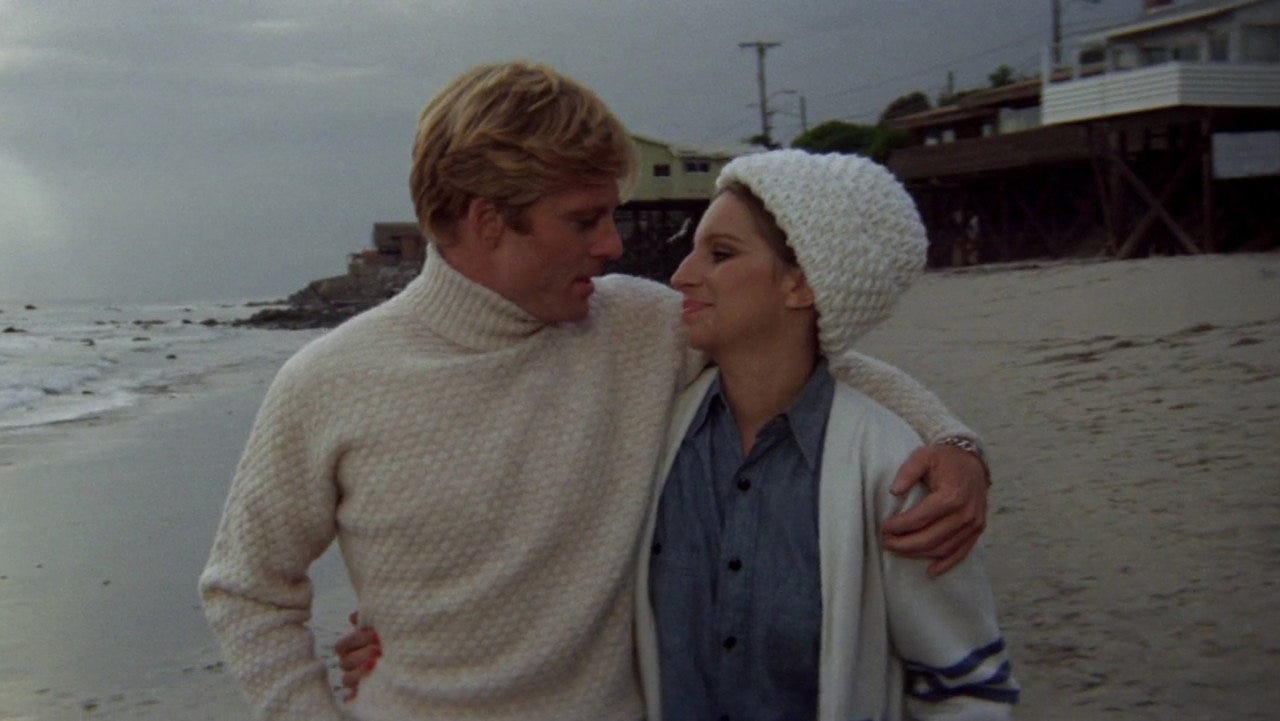
The movie that reached theaters is gentler than the one they shot. After two sneak previews in San Francisco in July 1973, Pollack cut most of the politics — “audiences were just plain bored when we got into the politics,” he said.
Smiles We Left Behind
But no one who’s seen the film can forget its love story or its melancholy final scene. It’s hard to find a more powerful moment shared between two icons at the height of their powers.
Marvin Hamlisch and Alan and Marilyn Bergman won Oscars for the score and the title song, and in February 1974 “The Way We Were” became Streisand’s first number-one single. On Sunday, before the film, soloists from Hewlett-Woodmere will perform songs inspired by the movie.
The Afternoon
1:00 PM — Program begins
1:05 – 1:15 PM — Robert Redford tribute, hosted by Yelena Fradlis
1:15 – 1:25 PM — Music inspired by the film, performed live by Hewlett-Woodmere soloists
1:30 PM — The Way We Were (1973), 118 minutes
~3:30 PM — Audience Q&A
Location: Gold Theater at the Hewlett-Woodmere Public Library, 1125 Broadway, Hewlett, NY 11557
FREE ADMISSION. Free and open to everyone, as always.
Your girl is lovely, Hubbell.
See you Sunday. Bring your hankies.
The Cognitive Film Society is a 501(c)(3) nonprofit dedicated to cultivating film culture through educational programming and community engagement.