



Editor’s Note
Yelena Fradlis returns with a piece that moves from costume design to monumental sculpture. Richard Serra died in March 2024. His work at the Nassau County Museum of Art remains—worth your Sunday morning. - DH
To stand before a Richard Serra sculpture on a somber January morning is to enter a cinematic space where you are both the lead actor and the lens. Before Serra transformed landscapes with colossal walls of steel, he was documenting the raw, human friction of effort and gravity through the camera.
The Cinema of Effort
His early films are not merely “movies”; they are studies of the human spirit grappling with the material world. When we watch his first film, Hand Catching Lead (1968), we witness a hand tirelessly attempting to snatch falling lead—a rhythmic, almost desperate dance of focus. In Hand Lead Fulcrum (1968), we see the artist himself struggling under the literal weight of a lead cylinder.
These films mirror the internal “perceptual gap” we all feel in the quiet of winter. As we stare at the frozen steel plates at the Nassau County Museum of Art, we see a reflection of our own resilience. Like the methodical sweeping of steel shavings in his collaboration with Philip Glass, Hands Scraping (1968), our lives are often composed of these repetitive, quiet labors of maintenance and care.
Reflections in the Metal
The Cor-Ten steel, with its deep umber patina, acts as a monumental mirror for the soul. In the stark light of a New York winter, the metal doesn’t just block the path; it frames our thoughts.
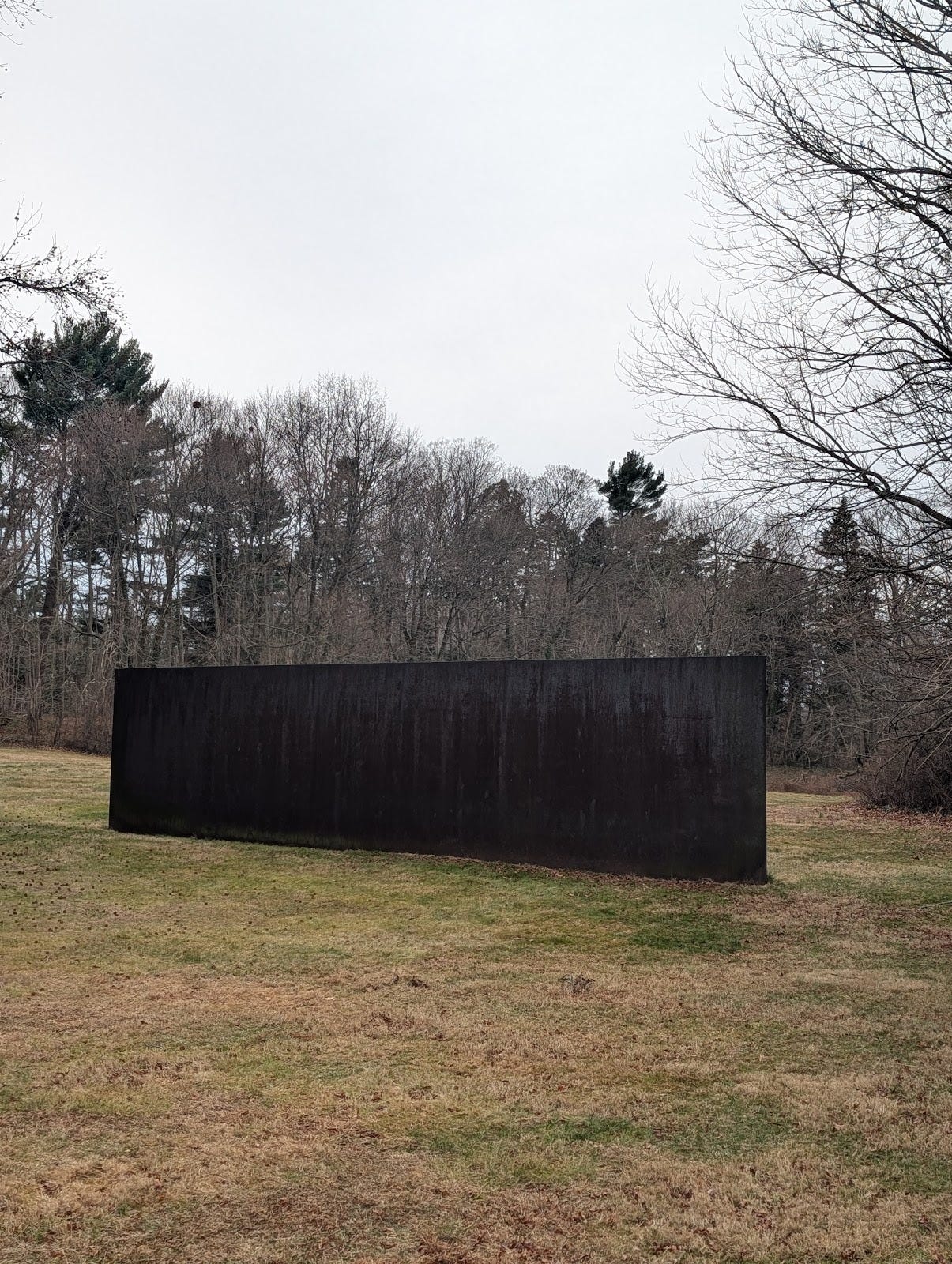
The heavy industrial presence validates the weight of our own inner reflections. The rust is not decay, but a protective skin—a marking of strength through vulnerability. Just as Serra’s film Frame (1969) explored the difference between what the eye sees and what the camera captures, the sculpture garden invites us to notice what we usually overlook in ourselves.
Visit the Grounds
The healing power of this landscape lies in its accessibility. The interplay of art and nature is a dialogue that never closes, offering a sanctuary for those seeking a moment of cinematic clarity.
Location: Nassau County Museum of Art grounds, Roslyn Harbor
Hours: The grounds and sculpture garden are open sunrise to sunset
The Experience: Walk the 145 acres and let the Serra sculptures “edit” your view of the trees and the sky
To read more: The Films and Videos of Richard Serra - Harvard Film Archive