


“Who’d say that proud Salieri has ever been
A despicable envier,
A snake trampled by people, alive,
Powerlessly biting sand and dust?
None!.. But now – I say it myself – I’m now
An envier. I envy; deeply,
Painfully envy. – O heaven!
Where is justice when the sacred gift,
When the immortal genius – not as a reward
For ardent love, selflessness,
Toil, diligence, prayers – was sent –
But illuminates the head of a madman,
An idle reveler?.. O Mozart, Mozart!”—Emil S. translation of Pushkin’s “little tragedy”, Mozart and Salieri
If there were a manifestation portal open in the vast cosmos of our fine and deteriorating universe for me to humbly submit a wanting, then let my siren song be heard. If by some strange yet dreamworthy chance I were ever inclined to give interview with the stealthish and somewhat elusive Letterboxd socials team, I have my first film selection offering to prelude their viral “top 4” questionnaire.
This is a film that lived inside the mouth of my parent’s Sanyo television set, above a treasure trove of well-loved boxes that contained every analog VHS daydream necessary to coax my precociously distractible mind. Tapes of Shirley Temple, Mario Lanza, Jacqueline Du Prè, and Van Cliburn became the soundtrack to my infant years, accompanied by a lingering yet spontaneous waft of Shikumen syle braised spareribs with bamboo or my Nonna’s Sunday Ragù Napoletano. This is a film that eventually suffered an untimely demise, due to my incessant rewinding and constant replay. There was never an eject button pressed that was not followed by an immediate and ungraceful tape load.
But enough muffaletta memories.
The picture I’ve chosen to fuss over, is Amadeus.
Amadeus (1984), the forty-time award winning classical composer biopic-adjacent film by mythical Czechoslovakian auteur, Miloš Forman, has been said to have drawn initial inspiration and satirical substance from Russian Romantic poet and playwright Alexander Pushkin’s poem, Mozart and Salieri.
Aleksandr Pushkin (born May 26 [June 6, New Style], 1799, Moscow, Russia—died January 29 [February 10], 1837, St. Petersburg) was a Russian poet, novelist, dramatist, and short-story writer; he has often been considered his country’s greatest poet and the founder of modern Russian literature…
After returning from exile, Pushkin found himself in an awkward and invidious position. The tsar’s censorship proved to be even more exacting than that of the official censors, and his personal freedom was curtailed. Not only was he put under secret observation by the police but he was openly supervised by its chief, Count Benckendorf. Moreover, his works of this period met with little comprehension from the critics, and even some of his friends accused him of apostasy, forcing him to justify his political position in the poem “Druzyam” (1828; “To My Friends”)…
Yet it was during this period that Pushkin’s genius came to its fullest flowering. His art acquired new dimensions, and almost every one of the works written between 1829 and 1836 opened a new chapter in the history of Russian literature. He spent the autumn of 1830 at his family’s Nizhny Novgorod estate, Boldino, and these months are the most remarkable in the whole of his artistic career.
During them he wrote the four so-called “little tragedies”—Skupoy rytsar (1836; The Covetous Knight), Motsart i Salyeri(1831; Mozart and Salieri), Kamenny gost (1839; The Stone Guest), and Pir vo vremya chumy(1832; Feast in Time of the Plague)—the five short prose tales collected as Povesti pokoynogo Ivana Petrovicha Belkina (1831; Tales of the Late Ivan Petrovich Belkin); the comic poem of everyday lower-class life Domik v Kolomne (1833; “A Small House in Kolomna”); and many lyrics in widely differing styles, as well as several critical and polemical articles, rough drafts, and sketches.—Encyclopedia Britannica
It would seem that Pushkin grappled with the literary and allegorical device of cardinal sin, much like many of his other Russian Romantic contemporaries. Goncharov’s Oblomov is a 500 page meditation on sloth, Dostoevsky’s Crime and Punishment explores Raskolnikov’s pride and hubris, and Tolstoy’s Anna Karenina is basically an unrelenting foghorn warning—shouting at all not to commit adultery or emphasize lust as the reliable companion to sound decision making.
Amadeus could be seen as an exploration of envy. A nuanced yet universal envy; only of immediate visibility to the two inflicted in toxic lockstep. Miloš Forman is not the only artist to draw from the Russian Romantic set and their philosophically sticky œuvre of divine justice, sublime intervention and mortal sin. Pushkin’s foundational source material became a Mary Poppins-esque bag of neverending inspirational depth, filled with Russian nationalist composers’ and their artistic contributions. Mussorgsky’s Boris Godunov, Tchaikovsky’s Eugene Onegin, even an opera with a verbatim libretto, Rimsky-Korsakov’s Mozart and Salieri.
But for more on Forman’s Amadeus—seeing as it is arguably the most accessible and easiest to finagle an opinion into—we must address Peter Shaffer’s 1979 play by the same name. Shaffer’s play ran over 2000 performances between Broadway and London’s theatre districts. When asked by The Guardian in 2013, Shaffer said on his inspiration for writing Amadeus:
“I came up with the idea for this play after reading a lot about Mozart. I was struck by the contrast between the sublimity of his music and the vulgar buffoonery of his letters. I am often criticised for portraying him as an imbecile, but I was actually conveying his childlike side: his letters read like something written by an eight-year-old. At breakfast he’d be writing this puerile, foul-mouthed stuff to his cousin; by evening, he’d be completing a masterpiece while chatting to his wife”—Peter Shaffer and Felicity Kendal on Amadeus
When Forman began the adaption to film, he worked closely with legendary conductor and violinist, Sir Neville Marriner CBE, also affectionately known as one of the greatest conductors to have ever lived. Forman chose pieces with Marriner according to rhythmic structure, emotional tone, and often times, with a stiff upper lip sense of irony. A few examples include:
The Serenade for Winds (Gran Partita) — We are introduced to a decrepit, quasi undead Salieri in the sanitorium post attempt. As we’ve leered into his inner mind and introductory self, the room ominously darkens as he describes Mozart. Wolfgang, Amadeus, Mozart. He proclaims of this piece, as his first impression of the young Salzburgian, “The beginning simple, almost comic. Just a pulse – bassoons and basset horns ~like a rusty squeezebox~. And then suddenly, hiiiiiigh above it, an oboe, a single note! Hanging there! Unwavering… until a clarinet took it over. Sweetened it into a phrase of such delight! This was a music I’d never heard. Filled with such longing, such unfulfillable longing. It seemed to me that I was hearing the voice of God.”
And with any other composer of that period, still lamenting Lully and showing utmost reverence to the Esterhazy-court beloved Haydn, they would have predictably set this ensemble to string. But Mozart? Our little genius of a strudel set his Gran Partita to winds only. A multitude of sustained, crystalline, otherworldly woodwind melodies in perfect tandem and harmony. Sounds that lift even the darkest depths of one’s weary soul. The entry of the oboe instills a welcomed and uncontrollable frisson.
The Abduction from the Seraglio — Forman ambitiously tackles the iconic catalogue of Mozart’s operatic compositions and libretti. He included a lesser known opera to deliberately match the script’s subject. Though, from a more analytical lense, this could be the beginning of criticism toward Salieri’s depravity.
We see him piously beg in previous to be rid of his lust, his pride, and his desires. He pleads with Christ, for salvation in return for his utmost chastity and deliverance from sin. Yet, here we witness him accompanying a student he only sees, to satiate his overwhelming flesh-based desires. He is deeply enamored and obsessed with Katerina, the soprano donning all Turkish themed attire, for fear of not observing her trendy hairstylist’s advice. Through flirtatious asides and presumably silly shenanigans involving genitalia, Mozart eventually gets his quill into Katerina. He writes her a primadonna part, officially cementing her as the chanteusse du jour and now, Salieri as his direct opponent. I believe we can see how envy plays a natural, undeniable role in Salieri’s behavior and public being. Try as he desperately might, jealousy slips through the corners of his lips, promptly poisoning his promise to Christ. When the illiterate albeit lovable Emperor values Mozart’s opera at “too many notes”, we are immediately fed an unappetizing dish of unfiltered, realistic truth through the timeless human experience of disappointment. The message that genius, does not supersede mediocrity. Being liked however, does.
But, having mediocrity, affability, and power? Meet Antonio Salieri.
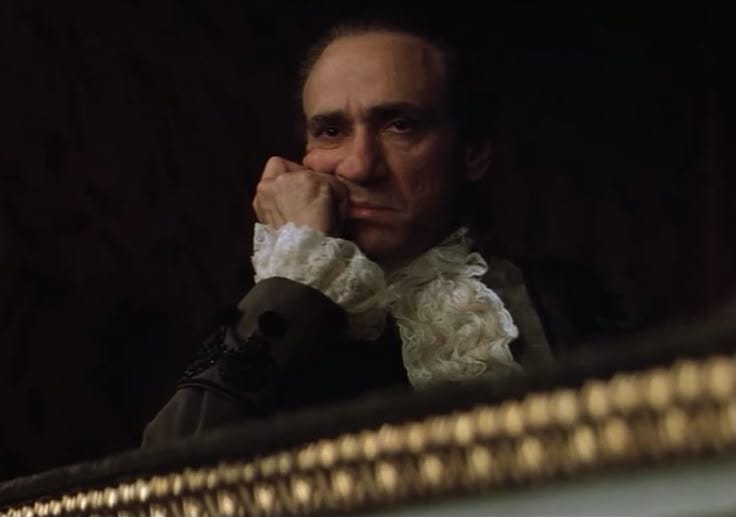
We are shown a deliberate juxtaposition from Mozart’s opera to Salieri’s posterior-kissing pomp and circumstance, (Axur, re d’Ormus, “Axur, King of Ormus”), the Emperor titillating. As a musician, one is usually opposed to pitting composers against one another, especially when such salacious rivalry never existed in reality. Pushkin’s Salieri character is unfortunately just that—a character. In history, Antonio Salieri was an incredibly nuanced and well-respected operatic composer, completing almost 652 musical works in his life. Operas and stage works alone surpassed 40 pieces, without the inclusion of his orchestral masses, requiem, oratorios and offertories.
Whether or not his work had artistic merit isn’t necessarily the usual, proposed question. In the context of Amadeus however, one is inclined to turn their nose upward— out of principal.
Ma certo, how can we not speak on Act III?
The Requiem — The doom-impending, foreshadowing piece summoned by a masked stranger, wearing what can only be assumed is a facial covering modeled after those in vogue during the Black Plague. In a quasi-meta, life imitates art but with a tinge of psychosis and schizophrenia shift towards the third act, we begin our descent into Mozart’s Requiem.
As Salieri plots to single-white-female Mozart, connivingly usurping unearned historical glory, we see that though an unfathomably impossible genius, reality is still a sobering reflection. Mozart has gone hungry. Gaunt, sickly, and frail with pneumonia; a disappearing Mozart gambles and drinks away his brief glimmer of fame and prosperity. The masked taunter pays Mozart to swiftly finish a requiem, a mass for the dead. As he works tirelessly—when not drunkenly frolicking amidst forest fueled sex parties—the composition process deteriorates his spirit. And eventually, ushers in iconic, premature death.
Latin:
Confutatis maledictis,
Flammis acribus addictis,
Voca me cum benedictis.Oro supplex et acclinis,
Cor contritum quasi cinis,
Gere curam mei finis.English translation:
When the accursed have been confounded,
consigned to the fierce flames,
call me among the blessed.I pray, suppliant and kneeling,
a heart contrite as ashes,
take Thou my ending into Thy care.
“Confutatis Maledictis” is a Latin Catholic traditional text, from the Dies Irae sequence, dating back to the 13th century. It is a liturgical text in the public domain. Mozart’s use of male vocalists as an audible suggestion of flames and fury, in contrast and accompanied with female choir voices begging for salvation, is an example of his multi-dimensional and perfect compositional prowess. A genius, with a God given message.
As the reverie of hair-raising, sonically superior storytelling comes to an end, and our titular hero of God-like talent is thrown into the earth’s crust without even so much as an epitaph of remembrance; the viewer is confounded with a moral apprehension. A queasiness of uncertainty, pangs of uncomfortable truth. We are forced to confront the message of merit, and all of its unpromised promises. We are shown that genius is a gift, and earthly pleasures can never measure. We are warned that deterioration through sin is possible, and the only sure way to let most mediocrity win.
Perhaps we are meant to see such, and pivot.
Be childish in your curiosity like Mozart, inquisitive and hilarious like Mozart. With the cunning awareness, superficial superficiality, and clear-headed calculation of a seasoned reptile, like Salieri. Live well like Salieri. Be successful and learn what works, like Salieri. Keep the talent, save the hope. Show the strength, soft like water. Create constantly, showcase strategically.
Or, live and create as though every day were your last, because with Pushkin, it very well may be.
[insert iconic maniacal cackling synonymous with Amadeus.]
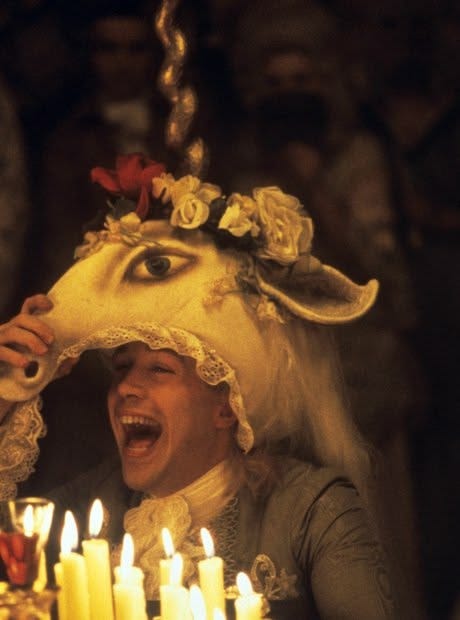
Commenting on your own piece is such tasteless and flagrant self-promotion.
Anyway, here's my piece for CFS.
💞