



The night Diane Keaton died, I put on Something’s Gotta Give (2003).
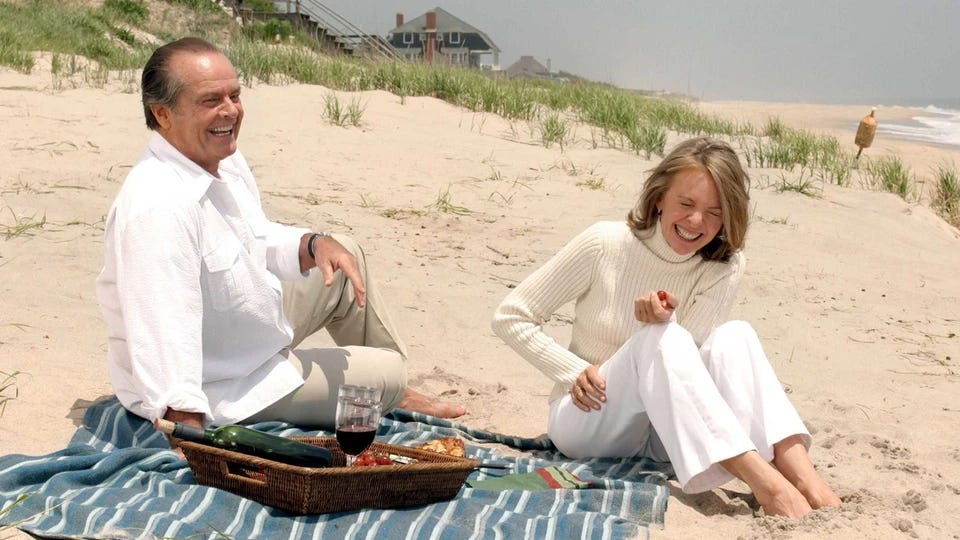
I don’t know why that was the one. Not Annie Hall, not Manhattan, not any of her more “serious” roles. I think it’s because I needed to see her happy. Laughing on a beach. Being adored by Jack Nicholson in a way that felt — for once in a Jack Nicholson movie — completely earned.
She really was a woman to love.
Over the next week I went through a fair amount of her filmography.
Love and Death (1975), where she’s spouting pseudo-philosophy peppered with vaudevillian punchlines and you realize nobody else in Woody’s orbit could land both at the same time. First Wives Club (1996), where she plays the straight woman against Bette Midler and somehow holds the center. Manhattan (1979), which I’ve seen a dozen times and I’m still not sure it’s possible to make a comedy that good anymore.
Then Looking for Mr. Goodbar. Interiors. The Godfather films. Reds. All of it.
When I got to the end of that week, the film I kept coming back to was Annie Hall.
Not because it’s her best performance — I’m not sure it is — but because it’s the one where everything she could do came together in a single role that changed American cinema.
That’s why we’re screening it on March 29th.
To understand why Annie Hall matters, you have to understand what Keaton was doing in the years around it. As one of the premier actresses of her generation, she was moving between worlds while defining the era of “New Hollywood”.


She was 26 when she played Kay Adams in The Godfather (1972). Acting opposite Brando and Pacino and Duvall and Caan — and she was the one you couldn’t stop watching.
Not because she commanded the room, but because she was listening. Kay believes Michael when he says That’s my family, Kay. It’s not me. We all did. Then Part II (1974) makes you pay for believing him.
That scene where Kay tells Michael what she did — what she did to survive him — Keaton plays it completely still and absolutely intense.
The same year as Annie Hall — 1977 — she made Looking for Mr. Goodbar. Richard Brooks adapted it from Judith Rossner’s novel about a schoolteacher who cruises singles bars, and it’s a very difficult watch.
Keaton plays Theresa Dunn as someone who wants liberation but has no framework for it — a woman caught between the Catholicism she was raised on and a sexual revolution that promised freedom but delivered something uglier. A tour de force by Keaton, who (thankfully?) never went this dark again.
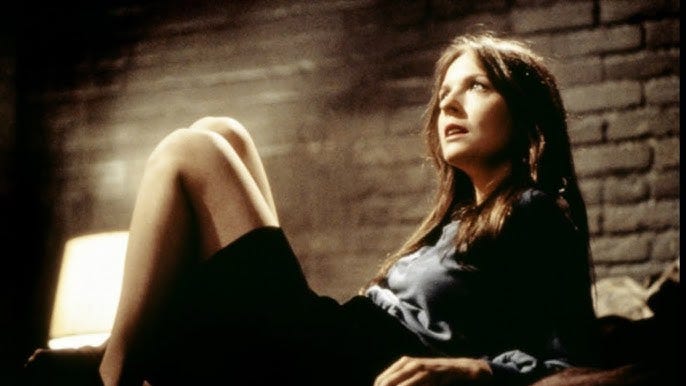
Annie Hall in the spring, Goodbar in the fall, same actress, two completely different women.
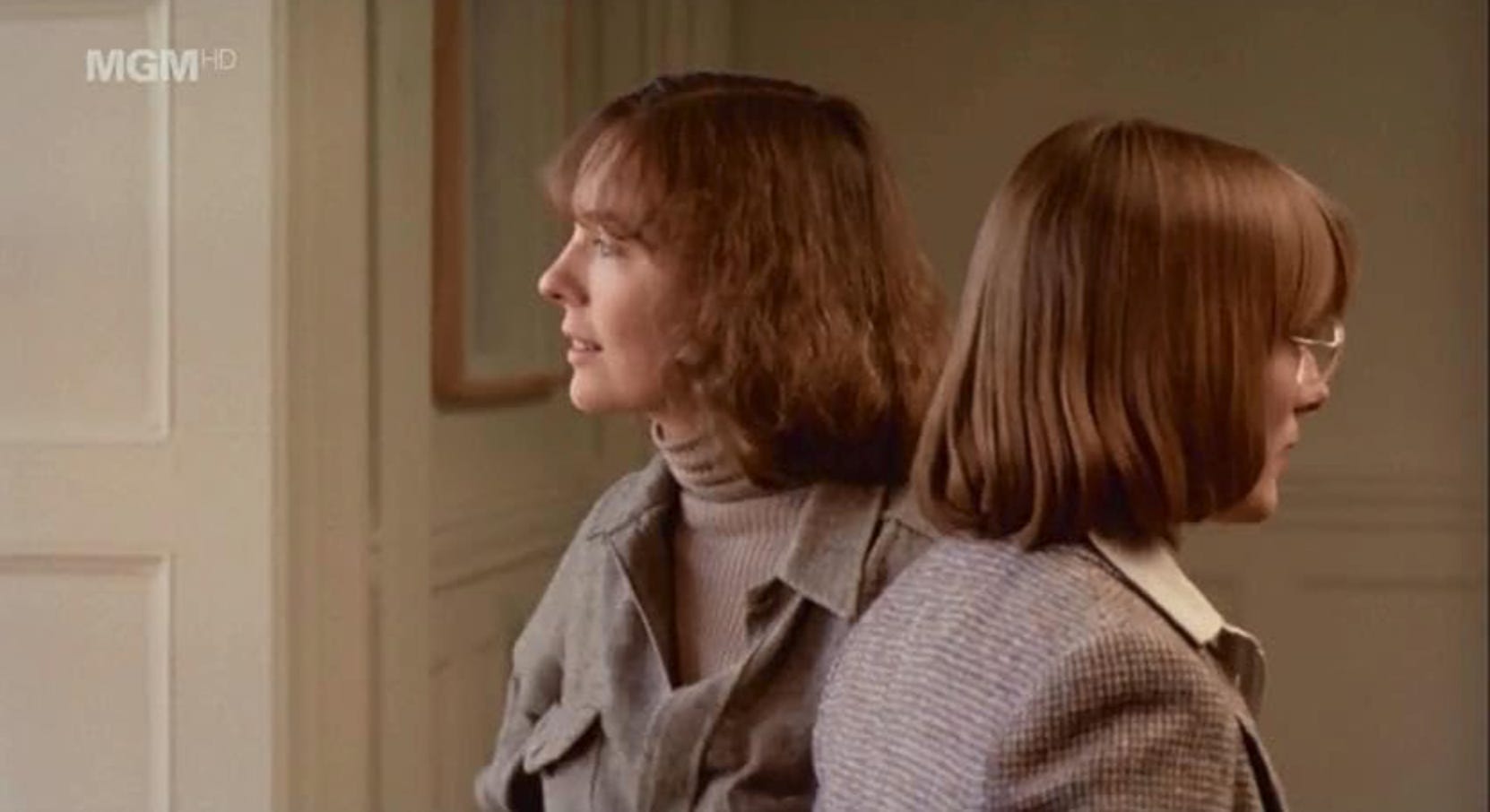
Then in 1978, Woody made Interiors — his quietest film, where the ripping of tape or the smashing of candle glass hit you like an artillery shell. Three sisters dealing with their mother’s collapse and their father’s remarriage — Keaton plays Renata, the eldest, the one holding everything together while falling apart inside. The performances are so over the top amazing that what could be a very boring film becomes something you can’t look away from.
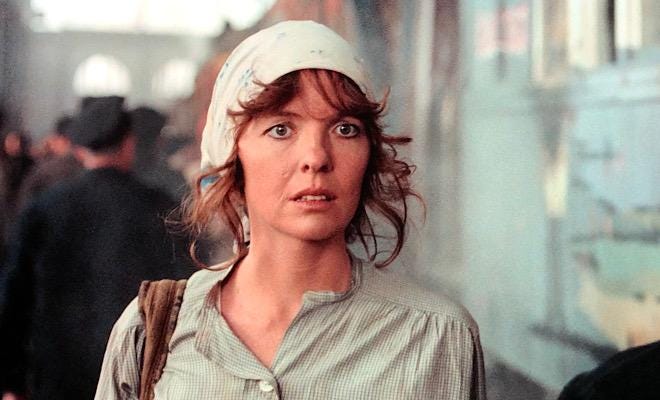
And then Reds (1981). Warren Beatty’s three-and-a-half-hour epic about John Reed and Louise Bryant — and Keaton holds the entire thing together. She plays Bryant as someone who fights for her own identity against a man whose cause keeps swallowing her whole. There’s a scene where Nicholson, playing Eugene O’Neill, tells her what she already knows about Reed going back to Russia. It really says it all. She won the Oscar for Annie Hall, but Reds might be the performance that proves her range was bigger than any single director deserved.
We tell the story of the New Hollywood as a story about directors — Coppola, Scorsese, Altman, Allen — and then about actors — Pacino, De Niro, Nicholson. But Keaton, alongside Dunaway, Burstyn, Rowlands, Clayburgh — they forced the revolution to take women seriously. Dunaway was the face of Bonnie and Clyde (1967) and Chinatown (1974) and Network (1976). Burstyn won the Oscar for Alice Doesn’t Live Here Anymore (1974). Rowlands did things for Cassavetes that no other actress could have survived. Clayburgh in An Unmarried Woman (1978) basically invented the post-divorce movie.


But Diane Keaton was the one who landed hardest inside the culture.
Because Annie Hall wasn’t an art film or a thriller or a family epic. It was a romantic comedy — and she played a woman who stammers, who second-guesses herself. Annie isn’t performing confidence. She sings “Seems Like Old Times” in a nightclub and her voice is small and slightly off and completely beautiful. She goes to therapy. She grows. And then she leaves.
Keaton took a part that could have been the girlfriend and made her the whole film.
She kept working for another forty-five years after that.
Baby Boom (1987), The Good Mother (1988), Marvin’s Room(1996), Something’s Gotta Give, The Family Stone (2005) — comedies and dramas, leads and ensembles, Nancy Meyers and Woody Allen and everything in between. She directed. She produced.
She made the roles she wanted when Hollywood stopped writing them for women her age.
Diane Keaton defined vulnerability and independence for a generation of moviegoers. We’re honored to celebrate her legacy with a screening of her most iconic role.
On Sunday, March 29th at 1:00 PM, the Cognitive Film Society returns to the Gold Theater at the Hewlett-Woodmere Public Library to screen Annie Hall — and to celebrate the actress who made it possible. All of it on the big screen where it belongs.
The Afternoon
1:00 PM — Program begins
1:05 – 1:15 PM — Diane Keaton tribute
1:15 – 1:25 PM — Musical performance by Aleksy Fradlis and Victoria Brodsky
1:30 – 3:00 PM — Screening of Annie Hall (1977)
3:00 – 3:30 PM — Audience Q&A
Aleksy and Victoria return to the Gold Theater after bringing the house down at our Detour and Gilda screenings — this time honoring Annie Hall through its music, the standards that soundtracked Alvy and Annie’s New York.
We may also be joined by our friends from the Malverne Cinema Arts Center, who’ll talk about New Hollywood and share an update on the progress of the arts center. More on that soon.
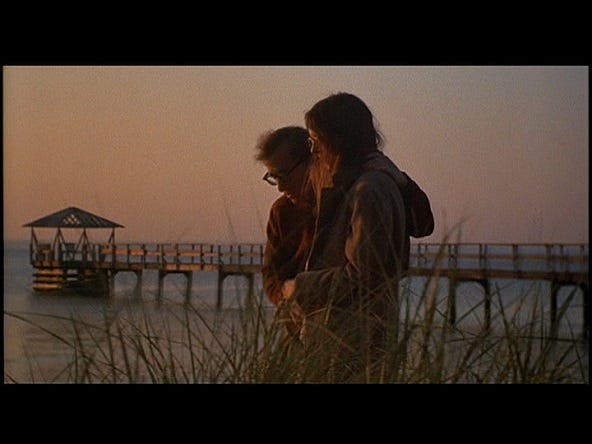
La-di-da.
The Cognitive Film Society is a 501(c)(3) nonprofit dedicated to cultivating film culture through educational programming and community engagement.